The PJ (poor joke) above might no longer remain a PJ if banana peel is replaced by a typical problematic situation one encounters in daily routine. The question remains unanswered then: Why do some people find it difficult to act beyond cure? They do think 'Prevention is The Best Cure' though! I was no different from them! But now my journey is gathering speed, hopefully in the direction that the blog is supposed to drive towards. Checkout my other blogs and work at http://www.worldOFkaizen.com/
Showing posts with label Opportunity. Show all posts

Wednesday, 1 February 2017

Water Matter

Study the two videos attached!

What do they suggest?

One of the videos shows the amount of water that goes down the drain (rather gets wasted) in a single flush stroke.

The other one shows the wastage of water is reduced considerably.

The latter was a case of handling the lever consciously to release it early enough so that only needed amount of water is used.
Sometimes it's a case of wrong setting or lack of maintenance, both resulting in the lever getting stuck. See picture-1.

In any case, human is to err!
The error however results into defective output and hence it produces waste.

But then what can one do?

See picture-2. This one is a mistake-proof (called as Poka-Yoke Kaizen in Japanese industry!) design of the flush tank.

It has two levers side by side: one for economy flushing and the other for normal flushing. The user needs to choose the right one consciously of course! Another opportunity for Poka-Yoke that is!

It's good to eliminate defects and waste early enough at initial or design stage itself. That's why this pillar of TPM (total productive maintenance) is also called as 'early equipment management' or 'initial flow control' (IFC).

It's the job of everybody to think, workout and feed their ideas about probable failure modes (FMEA, failure mode and effect analysis) so that corresponding Kaizen solutions can be incorporated at design stage itself.

The objective is to make the offering easier, faster, and less costly to make it and service it as well. In fact the design should, as far as possible, be maintenance free during the life-cycle of the offering; the concept called life-cycle-cost.

Can the change advance from thoughts stage to action now?


Read a few relevant blogposts hereunder:

Change is a hearty game!
Rise-n-Fall in the Rain-Fall 
Take Habits For A Ride 
Can-changing-thoughts-change-a-nation
Do you exercise your choice meaningfully
Not-Soon, Says Monsoon
Rise-n-Fall in the Rain-Fall   

Tuesday, 24 January 2017

5-S reality in Virtual world!


The other day an intern requested for an industrial visit with me.

Normally, it's good to test such requests to know the purpose, their commitment and their preparation. So, I asked him to self-learn through some blogposts before he earns the privilege of the visit. He did do it and earned himself the industrial visit.

Having got impressed by the learning during the visit, he seemingly continued his self-learning.

"Sir I was thinking one thing.. how can we apply 5-S to the I.T. (information technology) industry where everything is virtual?"

I like questions!
Questions show that the mind-factory isn't on strike!!

What's the virtual world by the way?

Conventionally, virtual is virtual if it's without brick and mortar. Hardly anything in this material world is virtual in reality! Even in the spiritual world... where it is subtle though!!  The so-called virtual world does have some hardware, at the least such as, say, computer and corresponding devices for the I.O.T. (internet of things). The office itself that houses the table for the computer, the pendrives, the central processor room, corresponding SOP displays and spares, et all is a reality.

Of course, a typical virtual world primarily may have virtual files. Each file may have some words written on it. The words do get realised if corresponding thoughts are in place.

Good thoughts emerge if mind is free of clutter. Unneeded thoughts are the clutter that the Seiri step of the 5-S can help get rid off. Just as it releases some memory (brain) cells for storage of the needed thoughts, similarly doing Seiri of the virtual files and virtual folders releases some memory bytes and gigabytes for storage on the hard-disk of a computer.


A typical screen design: layout and positioning of information, color codes on it, etc. to make it look aesthetically attractive, and yet functional in performance, difficulty-free with maximum information display with optimised space utilisation, itself is about applying Seiton principles effectively and innovatively. 

Accessing the information just-in-time (JIT): easily in a single click without any waste is about applying 1-is-better principle of Seiri. It helps to keep information live and realistic so that real time changes can be effected while responding to the customer demands rather than based on forecasts.

It helps to keep information live and realistic so that real time changes can be effected while responding to the customer demands rather than from stocks based on forecasts.

Excessive stocks usually tend to be obsolete warranting Seiri on it to prevent obsolescence.

So, like in material world, all the principles of 5-Ss are equally applicable in the 'virtual and spiritual world' as well.

I could write this blogpost almost instantaneouy in reply to the query by the smart intern because Seiton of virtual files and folders was in place on my smartphone.

The picture of the book page that is in this post was handy because of its PEEP on my smartphone. I could accommodate many such value adding files on the limited space on my smartphone because of the Seiri of the unneeded 'unlimited' things (WhatsApp for instance) that don't find space on my phone.


A typical software programme itself applies Seiri technique to eliminate unneeded steps. That's why you see an APP getting smaller and smaller in (MB) size as part of its continual improvement.

So applying 5-S in virtual world is about 5 things:

5-S of the corresponding brick and mortar,
5-S of the corresponding Hardware,
5-S of the corresponding software programmes so that they become leaner,
5-S of the corresponding business related Big-Data so that extracting information out of it is faster,
5-S of the Mind (so that it helps attain meditative state faster).

Also read a few relevant blog-posts hereunder: Please do consider sharing this post or sharing your initiatives on above lines in comment box.

Make It Simpler, Rest Will Follow 
One-Is-Better for JIT 
How To Make A Difference 
Big-Be Or Bug-Be ! 
Treat Root-causes, Not Symptoms ! 
Nauseous Communication Gaps 
Do You Cleanup-After-Crisis 
Raam or Krishna-Shyam: Tell me Hey Raam! 
Will It Work Here?  
Some Moron ! Some Great !!! 
That's How Morons Work 
You seem Reasonable if you appear Un-reasonable 
Smart-Moron Who Breaks Your Glass  
WOW Work-Culture: By Telling or Selling 
Suggestions On-Sale, None-To-Buy 
Can-changing-thoughts-change-a-nation
Ridiculous Poison-culture versus Maverick Kaizen-culture 
Tolerate Once, Twice, Thrice? 
That's how some business partnerships work 
Taken-For-Granted ? You Deserve It !! 
Technology in-place, security dis-placed
IQ-EQ-or-SQ: What-is-more-important?
Do you know a Best-Career-Plan 
Customer or Custo-Mer?  
Experienced A Delightful Payment ! 
An Experience of Heart-and-Soul 
Less With More And More Gets Sore 
Should one care for value?  
ABCD of India Shining
Beware Of Political-Presentations 
Do You Cleanup-After-Crisis 
Hoarders Of Filthy Hoardings

Tuesday, 17 January 2017

Passion or Fashion?

7 P.M. Cool and pleasant evening. I was on an evening walk.

I was almost pulled by the rhythmic beats of Mridangam (a type of percussion instrument) from behind the hedge.

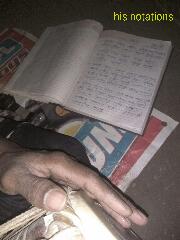
Raja (name changed) was practising, looking at the notations by his side. He could hardly read the notebook. He was sitting in dark at the farthest corner by the side of the eastern express highway in Thane.

For over five minutes Raja didn't even realise that I was standing by his side watching him play the Mridangam. My wife was watching patiently from a distance. She is used to such foolish halts of mine.

With a little bit of inquiry (finally when he looked at me), I came to know that he stayed in a rented shanty. His workplace was a few kilometers away. And that he sometimes came to practise in this corner whenever he got time. Once in a month he would go to his native near Murbad about 100 kilometres and take lessons from his Guru there.

What a commitment towards one's passion!

Whereas it is very easy to get spoilt (with smoking, drinking and chewing tobacco) in a metro city like Thane or Mumbai, the boy chose a corner and Mridang. The young boy (at 20 age) was pursuing his passion by the noisy and polluted roadside after work hours.

The reason: 

His neighbors would complain to his landlord about the 'noise' of Mridang. 

No room inside his room that he shared with a couple of partners.

Many 'innovate' hurdles to complain of 'why and how a thing couldn't be done' even after the corresponding resources were available in abundance. The young boy instead found solutions over his hurdles while nurturing his passion, staying alone 100 kilometres away from his family.

What an empowerment and self-enablement!

Sure to grow into a real life RAJA (King) of his passion if he continues to nurture it with consistency (rather than Passion as a Fashion) and self-managed supervision like Ekalavya.

Actually while I was writing this blogpost, my wife showed me a WhatsApp ping. It wrote "Joshua Bell, playing incognito in the D.C. Metro Station, that was organized by the Washington Post as part of a social experiment about perception, taste and people's priorities.

This experiment raised several questions:

In a common-place environment, at an inappropriate hour, do we perceive beauty?

If so, do we stop to appreciate it? " particularly when it comes free!

May be the boy is still to go far as a percussionist.

But what I wanted to appreciate was that that's how big names get made. In fact most successful people in various fields have left similar trails in their individual lives. They had little more patience to turn tables over while their problems were hell bent on testing them.

Their passions won over their problems by miles!

Big names get made when people find opportunities in problems without complaining about lack of resources, if any.

Big names get made (with holistic satisfaction as the result) when people find and nurture their passions rather than running after the run-of-the-mill careers.

Who knows (like Joshua Bell) sometime in life the boy may become a great percussionist if not Padma Shri Zakir Hussain!

In his humble mind, perhaps he already is!!

Here's my Haiku poem over the learning of the day:

Passion isn't a Fashion
Success isn't a cushion
Life is being in Motion


Also read a few relevant blog-posts hereunder: Please do consider leaving a comment or consider sharing this post.

Do you know a Best-Career-Plan
Take your career in fast lane!
Talent-Is-Latent: Enable It
Is Your Job Boring!
Overworked? Tension? CPU of the mind hung-up
Do you exercise your choice meaningfully 
IQ-EQ-or-SQ: What-is-more-important
Eternally Happy
In-a-problem? No-problem! Dwell-a-while
I am afraid ! What do I do !! 
Fearful-Of-Death-of-Birth
Take Habits For A Ride 
Big-Be Or Bug-Be ! 
Are You Good If Others Are Bad?  
Want Need-Or-Want 
How To Make A Difference 
Success-or-failure! What-do-you-like?
Succession-Plans In Fast Lane! 
Do you exercise your choice meaningfully
Do You Ask Right Questions
Carrier for the Career 

Is the Free cheap?

It was TIMES (of India sponsored) SANSKRUTI time!

Thane loves anything to do with cultural (Sanskruti for Culture in Sanskrit and most other Indian local languages) activities.

Since a last couple of years, the year had been beginning in Thane with a big bang of cultural programmes representing art from across India... be it 'Kesariya' song from Rajasthan in West to Manipuri dance from the far East and Kashmiri culinary art from the North to the Katthakali dance from deep South.

Among many other programmes to choose from, the celebrity stage was to present the pop-queen of India 'Padma Shri' Usha Utthup on the last day.

I was left with a coupe of tickets extra since my friend couldn't join due to his last minute commitment.

So I offered the tickets to someone standing near the entry gate eagerly trying to catch a glimpse of the stage: I've got this extra. Do you want it? Free!

He looked at me with suspicion about the 'Free' and turned his head away.

Then I walked a little. Asked a middle aged couple if they were interested. It's Free I said. They shrugged as if I was asking for some favour.

Finally I found two young (college going) boys: I've got this extra. Do you want it? This time I asked without saying it's Free. My intention was not to make it appear Free.

Momentary reply was No cash sir!

Then I explained to them (why) it's Free.

They grabbed it. I'm sure they must have enjoyed their grandma like Usha Utthup sporting her trademark Bindi on the forehead with a look of a lady in her 30s, with a soulful but melodious and powerful voice none less than that of a 17 year young girl.

Hats off to the talented 'Padma Shri' Usha Utthup for her lovely-n-lively presentation to a jam-packed 10,000 strong audience at the age of 70 with the same enthusiasm and passion that of (her own) 1970's.

The questions that brushed my mind were:

Although it may be inconsequential to the first couple of pairs to whom I asked, they lost the 'Free' opportunity that came walking over to them just because they didn't hear attentively to what I offered. Poor communication (perhaps from me)! Perhaps I asked wrong questions!

Often people tend to perceive before even they hear completely
People hardly listen actively!!

People have no value for the things they get free and get them without any efforts!

People choose to think Free is (always) Cheap!

Also read a few relevant blogposts hereunder: Please do consider leaving a comment or consider sharing this post.
Raam or Krishna-Shyam: Tell me Hey Raam!
Some Moron ! Some Great !!!
WOW Work-Culture: By Telling or Selling
Suggestions On-Sale, None-To-Buy
Ridiculous Poison-culture versus Maverick Kaizen-culture
Taken-For-Granted ? You Deserve It !!
IQ-EQ-or-SQ: What-is-more-important?
Take your career in fast lane!
Talent-Is-Latent: Enable It
Is Your Job Boring!
Overworked? Tension? CPU of the mind hung-up
Eternally Happy
Take Habits For A Ride 
Are You Good If Others Are Bad?  
Want Need-Or-Want 
Success-or-failure! What-do-you-like?


Wednesday, 4 January 2017

Can you do it like the likes of Suzuki and Toyota?

What is common between Maruti-Suzuki and your workplace?

A car every 12.5 seconds!
That’s what Maruti-Suzuki did in the year 2010!
There are plants around the world who may be making one every 1-second!!

What is important is answering the question, whether the corresponding plant are agile and flexible enough to adjust to the change in the rate of the demand from the market.

Yes companies like Suzuki and Toyota do it.
In their parlance this is called as running the plant by adjusting it to the tact time.

TACT is about ‘Time Allocated (by the customer) to Complete the Task’. During the process of fulfilling the customer demand, produce just-in-time (JIT) i.e. nothing more, nor less than what is desired by the customer. While doing so, their employees look for day-to-day problems as opportunities to improve and uproot the causes thereof to prevent their recurrence elsewhere as well.

In fact, not only Suzuki but many other excellent companies run their business learning from the TOYOTA (Kaizen Management) Way!


You can do it too!
You can create similar benefits specific to your business, customers and in fact for all the stakeholders as done by Suzuki and Toyota!!

The Kaizen way¹ of running an organisation is implemented there in a structured way.

Like in Maruti-Suzuki, Kaizen has improved quality and productivity in many organisations like Mahindra, TATA, etc. Kaizen made their processes leaner and faster to deliver in response to the ever-changing and pressing customer demands. It improved efficiency of (man, machine, material and space) resources, pruned  their costs besides achieving near-zero break-down, near-zero defectives and thereby near-zero customer complaint levels. All this is achieved at improved safety levels, reduced pollution and improved employee morale, motivation & involvement.

The journey (be it in manufacturing or service industries, from pin-making to air-lines or from hospitals to hotels) involves three stages.

First, the companies have to benchmark themselves against their past performance.
Then, they have to benchmark themselves against the best practices and companies in the world.
Third, the companies themselves have to become benchmarks worthy of emulation by others.
To achieve such a transformation, what is needed is making a beginning by transforming thoughts that you too can!

Also read a few relevant¹ blog-posts² hereunderPlease do consider leaving a comment or consider sharing this post.

Old-Problems, New-Reasons !
Ant Knocks Elephant Down 
Will It Work Here?
IQ-EQ-or-SQ: What-is-more-important 
Talent-Is-Latent: Enable It! 
Judge If It's Paralysis-By-Analysis 
Will It Work Here
Suggestions On-Sale, None-To-Buy 
Does recognition really matter 
Who Comes First: Consumer Or Customer ? 
Treat Root-causes, Not Symptoms ! 
ABCD of India Shining 
Do You Ask Right Questions?
Am I 'Short-sighted' or 'Long-sighted'
Who Comes First: Consumer Or Customer ? 

Tuesday, 3 January 2017

Carrier for the Career

Will I succeed in the career I choose and chase thereafter?

This is usually a question that lingers on the mind of most prospects.

In a couple of blogposts¹ earlier, I offered some guidance. In this one I would like to value add by offering some visual explanation.

There always exists some demand D, correspondingly some careers C and some passions P. In some cases, they overlap as in sketch-1 and in other cases they exist mutually exclusively as in sketch-2. 

Some people nurture their passions after office hours or at weekends. Those who do not know their passions may like to keep a journal of the activities that they enjoyed during working hours as well as after working hours and during weekends. Those could be the pointers to their passions!


Various types of demands could be due to the basic human needs (like food, shelter, clothing, security and education as in Maslow's hierarchical model) or due to wants (or so called glorified higher needs) as well.

CD arrow indicates that you may fall (burn) out of the current career irrespective of the demand being in place. This is true particularly if the both do not overlap the circle of passion.

PC arrow indicates that demand can get created if passion is in place and corresponding careers are available.

PD arrow indicates that career can be easily made if passion and demand both are in place.

If all of the P, C, D, co-exist then what's the problem?
Why does the doubt of 'success and failure' and that of 'choose and chase' exist?

One reason could be that the three might be floating around in isolation in their own P, C and D zones independently (mutually exclusively in the mathematical lingua), something like as you see in the sketch-2.

If however all the three overlap as in sketch-1 then the shaded zone (the green dot area common to P, C and D) is the most easier one for the prospects to succeed. That's because demand and careers are already available as a carrier for their passion to ride upon. In fact there'll be a pull from it for one's passion even if one may not want it.

Career chosen in this zone is where you are likely to make a major difference and leave your impact.

C and D (the orange and red dot areas) are where you need to push yourself very hard to create the carriers for a career to join the demand. You also need to work exceptionally hard to create skills and capabilities in line with the market demand. The reason is you need to work away from what you already have. The degree of push may vary a little depending upon the saturation level of the careers and the satisfaction levels of the demands as well.

Instead working on what you already have (your passion, the blue dot area) in order to enhance skills and capabilities in line with the opportunities that the market provides, creating the corresponding demand and career is much easier even if they hardly exist. You may have to do a little spadework though.

You may need to push very little to create a carrier for your career. You'll succeed anyway it being your passion. The criteria of success will more be enjoyment derived out of the process or journey rather than merely the earnings out of it. You are surely going to enjoy it because it's your passion that you are furthering it.

Those who understand this P-C-D interrelationship, don't have to worry about the Carrier for their Career. This is particularly true for the passionate ones because they are already 'play'ing the game of it rather than 'work'ing it out.

They already have answer to the question of 'choice and the chase'!
They are likely to be the most successful ones!!

Also read a few relevant¹ blog-posts² hereunderPlease do consider leaving a comment or consider sharing this post.

Footnote
Do you know a Best-Career-Plan
Take your career in fast lane!
Talent-Is-Latent: Enable It
Is Your Job Boring!

Footnote-² ... Other relevant blogposts
Overworked? Tension? CPU of the mind hung-up
Do you exercise your choice meaningfully 
IQ-EQ-or-SQ: What-is-more-important
Eternally Happy
In-a-problem? No-problem! Dwell-a-while
I am afraid ! What do I do !! 
Fearful-Of-Death-of-Birth
Take Habits For A Ride 
Big-Be Or Bug-Be ! 
Are You Good If Others Are Bad?  
Want Need-Or-Want 
How To Make A Difference 
Success-or-failure! What-do-you-like?
Succession-Plans In Fast Lane! 
Do you exercise your choice meaningfully

Do You Ask Right Questions
Overworked? Tension? CPU of the mind hung-up?


Saturday, 7 November 2015

Bored? ... It's an opportunity!

Are you bored?
It's an opportunity!

You are on a long drive alone. It's over an hour that you were driving. The road is straight, smooth, with hardly a car or two passing bye swiftly, and without any roadside shops too.

Driving at not less than sixty kilometers per hour it becomes so monotonous that you start getting bored. At times you make mistakes such as not slowing down at turns or rumblers. What do you do now?

You decide to take a break. You look for a choicest Dhaba (roadside eatery) around. Luckily you get one.

You stop! You take a bowl full of water... Splash it on your face. Standing by the side of a tree you take a fresh look at the mountains around... Feel great... Order for a special cup of tea... Look around noticing things and the happenings minutely by the time tea arrives... Enjoy the tea sip by sip...

You remember a few friends that were disconnected for a long time. You remember the time that you had spent in your native village.. the sea.. the silky white sand... Suddenly there's a flash of some ideas on a problem you had dwelled upon over a couple of weeks. You make a call to your colleague, give a couple of instructions. Now you feel good, relaxed and decide to leave.

Now you are driving with fresh insights.

Sometimes the daily routine gets so boring that you get stuck. You begin making mistakes. If you look at such boring moments with the above insight, actually the so called boring moments offer opportunities if you choose to take advantage of.

It's an opportunity to switch on to do something else other than the routine on hand: Something else that had been pending, some reading, some cleaning up leading to laying hands on a long-lost paper, some power stretches to compensate for missed exercise, reconnecting a couple of acquaintances with a couple of calls, or may be even a Napoleon nap.

The switch over with consciousness may turn out to be a creative break... Some new thoughts to be jotted down... Some new creations... who knows!

Boring moments are actually flashes of opportunities to do something else before getting back to the routine with fresh surge of energy!

Read a few relevant blogposts hereunder:

IQ-EQ-or-SQ: What-is-more-important?
Do you know a Best-Career-Plan
Take your career in fast lane!
Succession-Plans In Fast Lane! 
In-a-problem? No-problem! Dwell-a-while!
Do you exercise your choice meaningfully
Do You Ask Right Questions
Overworked? Tension? CPU of the mind hung-up?
No Time? Micro-Meditate! 
Talk In Order To Listen! 
Eternally Happy!

Prevention: The Best Cure! ... Is it really so?
Treat Root-causes, Not Symptoms !
Drove To Hell ... Almost !  
WOW Work-Culture: By Telling or Selling 
In a Problem?: No Problem ! Dwell A While !!
In-big-problem? Wear-hats-to-solve-it! Part-2
Big-Be Or Bug-Be !
You seem Reasonable if you appear Un-reasonable

Monday, 2 November 2015

How often do you hear VOC

Given an opportunity, which air-conditioner would you buy: split or window?

Would you buy 'split' at the price point of the 'window' unit?

Of course, I would go for 'split' at the price point of the 'window' unit. Less noise at lesser price! 

But I've not done so yet.
Not because the split unit is not available at the price point of the window unit but because I've been on a search for a split air-conditioner of which the diffuser is small enough to fit into the opening for a window air-conditioner. I am yet to be delighted on such an offering.

Like in most houses provision for a window unit is a given. 
Same isn't the case for a split unit which actually needs a smaller hole, much smaller than one for the window unit. Is it a design-flaw or is the exclusion itself by-design?

Whatever may be the case but above paragraphs have some Voice Of Customer (VOC) hidden in there that has potential to differentiate an offering. 

1/ For a builder-developer and an architect by providing a hole for a split unit at construction stage itself. This is to avoid the wastage of breaking the wall open for split unit.
2/ For an air-conditioner manufacturer-designer by making diffuser of a split unit small enough to fit into the opening provided for a window unit. This will create an opportunity for increased sale of the split unit.

From the configurations (see figure) of a typical manufacturer, you may find that none of the diffusers of the 'split' unit fit the 'window' width that is about 660 millimeters (standard). Of course, this is not until someone makes it to fit into the window and makes the customers aware of it thereby pulling 'window' unit customers to buy 'split' unit.


There are many opportunities if marketers and designers choose to innovate by mining into VOC such as above. Differentiated offerings as above could be possible by simple frugal innovations though many real innovations themselves are possible with frugal expenses on R&D if at all.

"How often do you hear VOC?"
Jokingly many reply: "Hardly any! Because she (customer) doesn't speak!"

Although this is fit to be a whatsapp reply, part of it is certainly true.

Customers are difficult to get to speak. Hardly any tell you what they want.
Fewer know what they need although they want to design their own life.
So somehow both the above types get rid of you by filling in the blanks in customer satisfaction survey forms in order to comply to your request. Analysis of such 'tick-marks' on the forms adds a little value if at all. 

If at all any of them do (speak), hardly 4-out-of-100 that are not satisfied with the offering, do so to complain reluctantly.
Rest leave without telling the supplier and join hands with the competitor.

Knowing this well some excellent companies capture VOC proactively.

Komatsu for instance fitted GPS-enabled software (KOMTRAX) in their equipment so that their engineers can capture and 'visualize' customer problems, needs, etc. in real-time as also they can value-add to their operations by updating them on their equipment utilization, etc.

Toyota for instance, fitted micro-phones in their new car models during test marketing so that they could capture 'feelings and expressions' of their customers that could be built into the product before commercially releasing them as competition to their own current models.

So do you have guts to cannibalize your own products before your competitors do?
Can't you make your customer speak, capture it, and build it into your offering faster than your competitor just as the Komatsus and Toyotas did?

Why not? 

Also read a few relevant blogposts hereunder:
Aesthetics Spills-Over Function, Want Spills-Over Need (Part-1)
Aesthetics Spills-Over Function, Want Spills-Over Need (Part-2)
Functional-Aesthetics
WOW Work-Culture: By Telling or Selling
How To Make A Difference
Nauseous Communication Gaps
Judge If It's Paralysis-By-Analysis
Suggestions On-Sale, None-To-Buy
Taken-For-Granted ? You Deserve It !!
Strategise To Achieve Targets Daily
Does recognition really matter
Customer or Custo-Mer ?
Experienced A Delightful Payment !
An Experience of Heart-and-Soul
Do you keep curing your brand ?
customer gets what s/he deserves: Shoddy Quality!
Listen to iceberg of VOC to acquire customers
Do You Force Customers To Quit
Should one care for value ?
Treat Root-causes, Not Symptoms !
Do You Ask Right Questions ?
Talk In Order To Listen